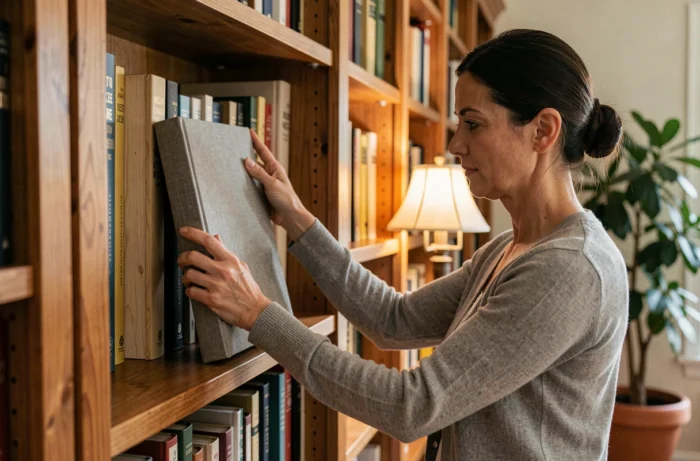
The spine of a book bears the majority of the mechanical stresses endured by the work. Each opening puts pressure on the glue at the back, the sewn signatures, and the covering material. Preserving the book’s spine means addressing daily handling as well as storage conditions, with technical choices that go beyond simple common sense.
Mechanical stresses on the spine: what digitization reveals
Digitization campaigns conducted by major research libraries, notably Oxford and Harvard, have highlighted a significant increase in damage to the spine and the edge of rare books. Systematic opening to 180° under powerful lights causes cracking of the glues, creasing of the paper at the central fold, and irreversible deformations of the binding after repeated scans.
This finding applies to all domestic handling. A paperback opened flat on a table experiences the same type of stress, simply distributed over a higher number of occurrences. The difference between a spine that lasts ten years and one that breaks after two readings often lies in the angle of opening.
We recommend never exceeding an angle of 120° during regular reading. For books with glued bindings (perfect bound), staying below 90° significantly extends the lifespan of the spine. Libraries and archives are replacing their flatbed scanners with V-cradle systems designed to digitize without flattening the book on the glass. The principle applies at home: a bookstand or reading cushion that keeps the book slightly open protects the structure much better than a flat surface.
Several techniques allow you to preserve the book’s spine in the long term, by combining handling practices and storage choices suited to the type of binding.
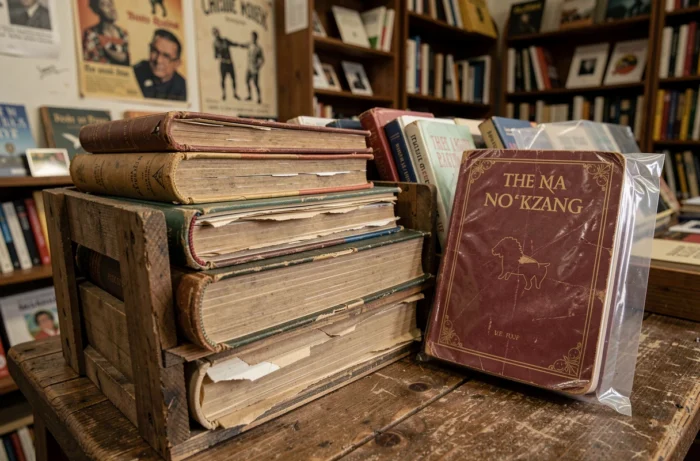
Vertical storage and position on the spine: common storage mistakes
Placing a book on its spine (spine up, pages hanging under their own weight) is the most destructive position for the binding. Professional library moving guides emphasize this point: a book should never rest on its spine. The weight of the signatures pulls on the covering, distorts the spine, and can cause the covers to detach within a few months.
The tight vertical position between two similarly sized books remains the reference. Three conditions must be met:
- The books are secured without being compressed: excessive lateral pressure crushes the joints and wears the covering cloth, while too much space allows the volumes to sag
- The books in the same shelf are of similar height: a large format wedged between two paperbacks experiences a permanent overhang on the spine
- Heavy or large format books that cannot stand without tipping are laid flat, stacked three or four high at most, spine visible outward
Cover materials and differentiated vulnerability
Not all spines react the same way. Vegetable-tanned leather ages better than industrially dyed leather, but remains sensitive to drying in dry atmospheres. Suede (split leather) collects dust and grease on touch, accelerating surface wear.
Canvas, used on most publisher bindings of the 20th century, is mechanically resilient but fades quickly when exposed to light. Parchment and alum-tanned leather, found on ancient books, are extremely sensitive to humidity variations and can become permanently deformed if the levels exceed conservation thresholds.
Humidity, light, and temperature: conservation parameters for the binding
The degradation of the spine is not only mechanical. The binding materials and the paper adjacent to the spine are directly affected by ambient conditions.
Excessively high relative humidity promotes the growth of mold on the spine, an area poorly ventilated when books are tightly packed on the shelf. Conversely, an atmosphere that is too dry causes the animal glues to shrink and the leathers to crack. Maintaining stable relative humidity, without abrupt fluctuations, protects better than reaching a specific number.
Direct light, whether natural or artificial, degrades the canvas and discolors the spines within a few seasons. A shelf exposed to a south-facing window shows visible damage in less than a year on fabric covers. We observe that libraries located in rooms with indirect lighting maintain their bindings in much better condition over time.
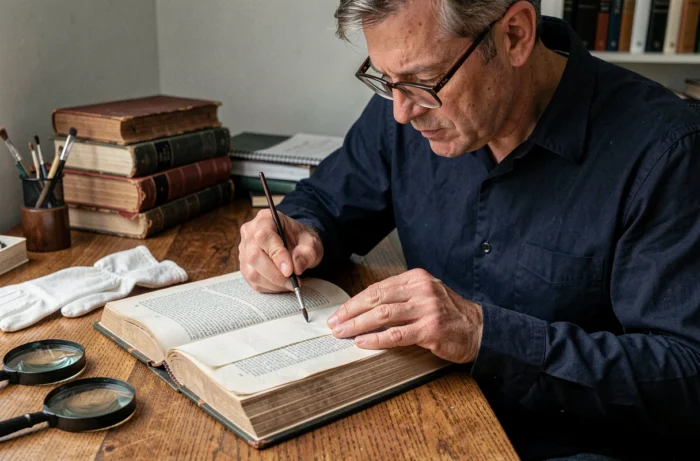
Preventive repair of the spine before complete breakage
Intervening on a weakened spine before it completely gives way avoids a heavy restoration. On a glued binding whose spine begins to crack, a reinforcement tape made of Japanese paper glued with methylcellulose stabilizes the structure without stiffening the whole.
For sewn bindings, the problem often arises from the joint (the hinge between the cover and the spine). When the fabric or leather cracks at this point, the covering gradually detaches. Reinforcing the joint with a strip of Japanese paper before total breakage is a simple intervention that extends the life of the book by several years.
- Clean the area with a soft brush to remove dust and dried glue residues
- Apply a thin layer of methylcellulose on the Japanese paper, not directly on the leather or canvas
- Place the strip following the direction of the paper fibers, then let it dry flat under a light weight for at least one day
Materials to avoid
Ordinary adhesive tape (like Scotch) is the worst choice for a spine repair. The glue yellows, migrates into the paper fibers, and leaves a permanent stain after removal. Vinyl glues (white glue) dry too rigidly for a spine that needs to remain flexible with each opening.
The spine of a book is an assembly of materials under constant stress. Every handling gesture, every storage choice, and every environmental parameter affects its longevity. The best-preserved books are not those that are never touched, but those that are handled correctly and stored under regular conditions.