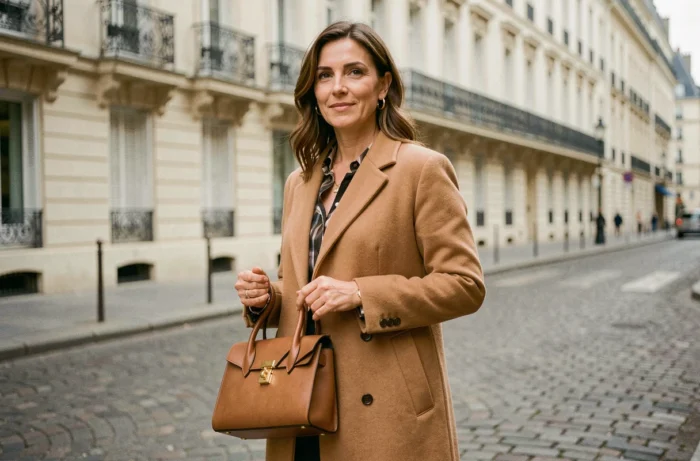
A luxury accessory is not chosen like a piece of clothing. The fabric of a jacket can forgive an approximate cut, but a piece of jewelry or a belt never will. The precision of the clasp, the grain of the leather, the weight of a bracelet on the wrist: these are the micro-details that betray or confirm a style intention. In a luxury market that is stabilizing rather than growing, accessories are capturing an increasing share of value, as they represent the most direct point of contact with the universe of a brand.
Resale value of luxury accessories: a selection criterion that has become technical
The majority of articles on style treat the accessory as an ornament. We are observing a paradigm shift: the luxury accessory is also a life-cycle asset. Certified resale already represents a significant share of second-hand luxury transactions, with a rapid professionalization of specialized platforms in Europe.
This observation changes the selection criteria. A grained leather bag from a historic brand retains its value better than a smooth leather model because the grain masks micro-scratches from use. A signed piece of jewelry with a brand hallmark and certificate of authenticity sells faster than an anonymous piece, even if the weight of precious metal is the same.
Before investing, we recommend checking three points: the presence of an engraved serial number, the availability of the original box and documents, and the model’s rating on certified resale platforms. These elements transform a pleasure purchase into a reasoned purchase, without detracting from elegance.
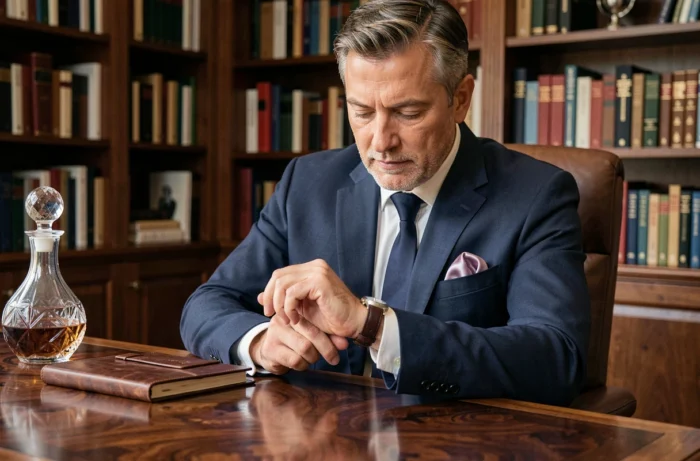
Luxury leather accessories: recognizing a finish that lasts
Leather remains the king material of high-end leather goods and belts. Not all leathers are equal, and the label “genuine leather” says nothing about actual quality. What matters is the tanning, thickness, and finish of the edges.
A vegetable tanning produces leather that develops a patina over time, while chrome tanning results in a more uniform but less vibrant finish. For a belt designed to structure the silhouette, we prefer full-grain leather of at least a few millimeters thick: it does not deform under the tension of the buckle, even after years of daily use.
The finish of the edges is a reliable marker. On a luxury bag or belt, the edges are painted by hand in several layers and then polished. On an entry-level product, the edge is simply cut and dyed. This detail can be checked with the naked eye: run your finger along the edge; it should be smooth and slightly rounded. Among the accessories on Tiffany and Co, this finishing requirement is found in small leather goods and jewelry pieces, where every detail contributes to the overall presentation.
Jewelry and silhouette: the proportion rules that ready-to-wear ignores
A necklace that is too short over a turtleneck, dangling earrings under a low bun, a wide bracelet on a thin wrist: these mistakes are not about taste, but about proportion. The accessory must create a controlled contrast with the area of the body it occupies.
Proportion principles for jewelry
- Long earrings elongate a round face but weigh down a narrow face. On a rectangular face, medium hoops balance the width.
- A choker highlights an open neckline. On a high collar, it disappears: prefer a long necklace that falls on the bust and creates a vertical line.
- Thin bracelets can be stacked, while cuff bracelets are worn alone. Mixing the two sizes on the same wrist creates a messy effect, not a stylish one.
These rules are not arbitrary. They stem from a simple principle: each accessory creates a visual line that interacts with the lines of the clothing. A V-shaped pendant echoes the line of a plunging neckline, a rigid bracelet mirrors the structure of a fitted sleeve.

Coordinating metals and colors without uniforming the outfit
The classic rule was to avoid mixing gold and silver. This convention has no technical basis since brands now offer two-tone alloys and satin finishes that blur the boundaries. However, one rule remains solid: the metal of the jewelry should match the metal of the utilitarian accessories.
If the belt buckle is in gold brass, the earrings and the bag clasp benefit from staying in the same family of warm tones. This is not about strict matching, but about overall chromatic coherence. The mix works when it is intentional, not when it results from an oversight.
Stone colors and undertones of the outfit
A common mistake is to choose a stone “that goes with everything.” Lapis lazuli, for example, does not tolerate warm beiges. It expresses itself on white, navy, or cool gray. Conversely, carnelian or amber pairs well with autumn palettes without forcing the contrast.
The simplest approach is to test the accessory with the outfit in natural light, not under artificial store lighting. The temperature of the light radically changes the perception of colors, especially on translucent stones.
Vintage luxury accessories: authenticate before buying
The second-hand market for luxury accessories is experiencing strong dynamics. A majority of European consumers now use resale platforms to acquire pieces from prestigious brands. This democratization has a downside: counterfeiting has professionalized at the same pace.
- Check the brand hallmark with a magnifying glass: on an authentic piece of jewelry, it is clear and regular. A blurry or asymmetrical engraving indicates a reproduction.
- Compare the weight of the piece with the specifications of the original model. A notable discrepancy indicates a different alloy.
- Request a certificate of authenticity issued by the brand or by a certified resale platform. “In-house” certificates self-issued by independent resellers offer no guarantee.
- Inspect the seams and finishes: on quality vintage leather goods, the thread does not fray, even after decades.
A well-chosen vintage accessory carries a patina that new items cannot replicate. A gold bracelet whose clasp has been polished by years of use, a leather clutch whose color has deepened over time: these signs of wear authenticate the piece as much as the hallmark.
Style is not built through accumulation. A single well-proportioned, well-maintained luxury accessory that is coherent with the outfit is enough to transform a silhouette. The rest is just visual noise.