
When you come home from work with a full head and an empty fridge, “taking care of yourself” feels like advice meant for someone else. The real challenge isn’t knowing that you should sleep better or move more. It’s finding where to fit these actions in when mental load, schedules, and budget leave almost nothing.
Mental load and lack of time: the real barriers to daily well-being
Most articles on well-being start from an implicit assumption: we have free time, we just lack motivation. In reality, this is rarely the case. Between professional obligations, household tasks, and unexpected events, the time available for oneself is counted in minutes, not hours.
The problem isn’t willpower. It’s the cognitive overload that prevents making any additional decisions at the end of the day. Adding a skincare routine or a fitness program then feels like piling another constraint onto an already saturated schedule.
You can also learn everything about Super Mamans to understand how certain approaches adapt these well-being actions to parental realities, without idealizing availability.
Financial well-being also plays a direct role: when the budget is tight, gym memberships or natural cosmetics take a back seat. Young adults, in particular, increasingly treat well-being as an integrated daily practice rather than a one-off luxury. This requires rethinking what “taking care of oneself” concretely means.
Taking care of your body without a program or equipment
You don’t need a training plan to reintroduce movement into your day. Ten minutes of walking after lunch already improves the quality of the afternoon. It’s a format that requires no special outfit, equipment, or mental energy to decide what to do.

For the body, a few simple actions are enough to lay a foundation:
- Stretching for two minutes upon waking and before sleeping, focusing on the shoulders and lower back, the areas that accumulate the most tension from sitting
- Drinking a large glass of water before morning coffee, which kickstarts metabolism without conscious effort
- Choosing the stairs whenever possible, even for just two floors, to maintain a minimum level of physical activity without blocking out time
These micro-actions do not replace regular exercise. Feedback on this point varies, and everyone deals with their own physical constraints. However, they create a foundation of consistency that helps you feel better without reorganizing your daily life.
Sleep and stress: two accessible levers without a budget
Sleep remains the most underestimated lever. We know we should sleep more, but we often compensate for fatigue with screens late at night, which exacerbates the problem. Turning off screens thirty minutes before bed is the first action to try, as it costs nothing and produces results in just a few days.
The blue light from phones delays melatonin production. Placing the phone in another room at a fixed time creates a clear break. You can read, listen to music, or do nothing. The brain eventually associates this signal with winding down for sleep.
Managing stress with what you have on hand
Deep breathing works, but we forget it because it seems too simple. Five slow breaths, inflating the belly, are enough to lower the heart rate. You can do this while commuting, in the office restroom, or while waiting for water to boil for tea.
Another concrete approach: write down three specific things that went well during the day. Not vague gratitudes, but facts. “The 2 PM meeting ended on time.” “Dinner was ready in twenty minutes.” This type of factual anchoring reduces rumination without requiring creative effort.
Nutrition and body care: simple formulas that work
Eating better doesn’t necessarily involve elaborate recipes. Preparing the basics on Sunday night (rice, cooked vegetables, proteins) allows you to put together decent meals throughout the week without thinking each evening. It’s batch cooking without the name, tailored for tight budgets.
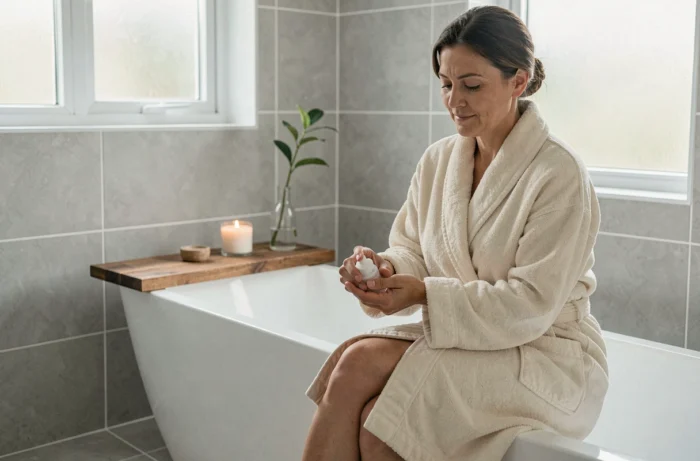
In terms of body and hair care, you don’t need to multiply products. A moisturizing soap for the skin, a basic vegetable oil for hydration after showering. Two actions, two minutes. The goal isn’t a complete beauty routine; it’s to maintain minimal attention to your body, which sends a positive signal to the brain.
What really matters in a care routine
Consistency outweighs product quality. A treatment applied daily with a low-cost product yields better results than an expensive serum used once a week. Consistency creates habit, and habit eventually costs no mental energy.
- Choose a single care action to integrate (face or body, not both at the same time) and maintain it for three weeks before adding another
- Associate this action with an already existing moment (after showering, before brushing teeth) so that it anchors in the routine without needing a reminder
- Accept that some days you might skip the step, without guilt or abandoning everything
Taking care of yourself daily doesn’t require transforming your life. One regular action is worth more than a perfect program that is never followed. The ten-minute walk, the phone set aside in the evening, the meal prepared in advance: each of these adjustments fits into the gaps of a busy schedule. That’s where they are useful, precisely because they demand nothing more than what you already have.