
On a Tuesday evening, 7:15 PM: the backpack is still in the entrance, dinner is barely underway, and the youngest has been asking for a screen for twenty minutes. We all know this kind of evening. A fulfilling family life is not built in a perfect setting, but in how we manage these moments of friction, night after night.
Parental mental load: what really weighs on family life
The first results published by the Parenting Today program show a clear paradox: the majority of parents say they feel confident and find parenting rewarding. At the same time, loneliness, fatigue, and psychological distress remain common.
We often talk about mental load as a vague concept. Concretely, it is the sum of invisible micro-decisions: who makes the medical appointment, who checks that the sports laundry is clean for Thursday, who anticipates the birthday snack. When one person in the household absorbs these tasks, fatigue accumulates without the other parent realizing the extent of the work.
A Pew study reported in 2026 confirms that work remains a major source of tension in modern family life. Many full-time parents report that their job complicates family organization, not because they work too much, but because the boundary between professional and private life has almost disappeared.
Rather than aiming for perfect balance, it is beneficial to identify the two or three mental tasks that generate the most tension in our home, and then explicitly distribute them. A shared chart on the fridge, even a basic one, makes visible what was not. Resources like La Voie de la Famille offer concrete ideas for structuring this type of reflection together.
Screens and digital pressure: the new family constraint
Competitors talk a lot about compassionate communication or gratitude in the family. None directly address the digital issue, even though it has become the daily friction point in most households with children.
According to a survey by the Anna Freud Foundation published in 2026, the majority of parents are concerned about the impact of social media on their child’s well-being. Parents are not asking for more studies: they want practical tools and better access to local support services.
On the ground, what works is not a harsh ban. We see better results when we negotiate a clear framework with the child.
- Define screen-free times for the whole family (meals, the first hour after school, the last half-hour before bed) rather than targeting only the children.
- Set up consoles and tablets in common areas to keep an eye on usage without constant monitoring.
- Replace “you spend too much time on your phone” with an open question: “what are you watching right now?”. The exchange changes nature when we focus on content rather than duration.
Feedback varies on this point: some parents notice a quick improvement in the atmosphere, while others take several weeks before the new framework is respected. Consistency matters more than the chosen method.
Children’s mental health: spotting signals in daily life
The same Anna Freud survey reveals that a minority of parents feel they have enough support for their child’s mental health. The priority need cited: practical advice and quicker support.
In practice, spotting distress in a child does not necessarily involve words. A change in behavior over two or three weeks deserves attention: a usually talkative child who becomes withdrawn, unusual sleep disturbances, a sudden refusal to go to school or to a friend’s house.
Three concrete reflexes when spotting a signal
You don’t need to be a psychologist to react appropriately. The first reflex is to name what you observe without interpreting: “I’ve noticed that you’ve been sleeping less well these past few days” opens more doors than “you’re stressed right now”.
The second is not to wait for the situation to worsen. Contacting the family doctor or school nurse is not an admission of failure; it is a preventive step. The third is to maintain daily rituals (meals together, bedtime stories, walking to school): these moments of stability reassure a struggling child much more than a formal conversation.

Concrete family rituals: what lasts over time
We read everywhere that we need to “spend quality time together.” The problem is that this injunction often induces guilt more than it helps. An effective family ritual is a short, repeatable ritual that requires no preparation.
- The dinner table round: each family member shares a positive moment and a difficult moment from their day. It takes five minutes and teaches children to articulate what they feel.
- The Sunday morning walk, even if short, even in the rain. Movement and fresh air relax everyone, including reluctant teenagers.
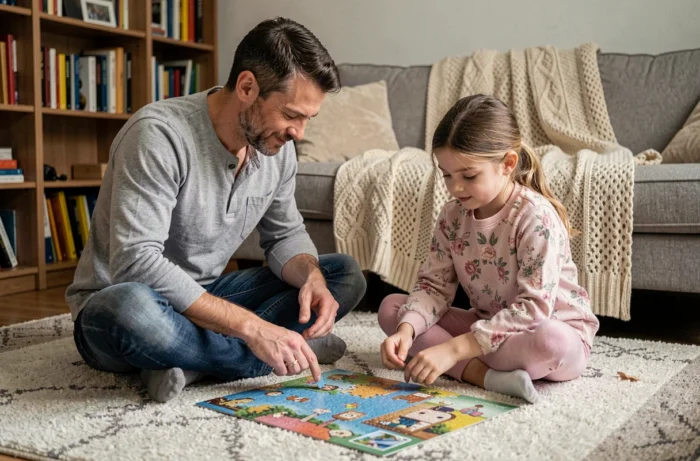
- A fixed time in the week where each child chooses the activity (board game, cooking, crafts). The autonomy of choice strengthens the sense of belonging to the family group.
These rituals cost nothing and do not require reorganizing your schedule. Their strength comes from regularity, not duration.
A fulfilling family life relies less on grand educational principles than on repeated micro-adjustments: making the mental load visible, establishing a manageable digital framework, staying attentive to children’s subtle signals, and anchoring two or three simple rituals in the week. It is these ordinary gestures, maintained over time, that change the atmosphere of a home.