
When a property manager receives the notice for the general assembly and must include the energy diagnosis, the question is no longer whether it should be done, but how to articulate this diagnosis with the resulting multi-year work plan. The energy diagnosis in co-ownership places the property manager at the center of a sequence of obligations where each step conditions the next.
Collective DPE and multi-year work plan: a sequence that the property manager must pilot
The collective DPE is often referred to as an administrative formality. In practice, it is the starting point of a complete cycle. The law has stabilized a pair collective DPE and multi-year work plan (PPPT) that requires the property manager to sequence diagnosis, followed by programming of the work at the general assembly.
The PPPT must rely on the results of the collective DPE to prioritize the work items: insulation, ventilation, collective heating. The property manager no longer simply orders a report from a diagnostician. They become the pilot of a mandatory cycle that goes from diagnosis to reserving the work fund.
In concrete terms, if the collective DPE reveals poor performance regarding the building envelope, the PPPT will need to include insulation work in its ten-year programming. The property manager bears the responsibility for this coherence between the diagnosis and the plan. An article detailing the role of the property manager on habitatfuturvert.fr co-ownership clearly specifies this articulation between regulatory obligations and operational management.
The obligation for collective DPE is gradually extending to all co-ownerships, including the smallest ones. Co-ownerships with fewer than fifty lots are affected by upcoming deadlines. The property manager must anticipate the schedule to avoid being late, which would expose the co-ownership to difficulties during the sale or rental of lots.

Energy audit in co-ownership: when the DPE is not enough
The collective DPE provides a snapshot of the building’s energy performance. For buildings classified in the least performing categories (labels E, F, or G), a detailed energy audit may become necessary to define quantified renovation scenarios.
The difference between DPE and audit is often misunderstood by co-owners. The property manager must explain that the DPE classifies the building, while the audit proposes prioritized bundles of work with estimates of energy savings. Feedback on this point varies among providers: some audits are very detailed, while others remain superficial.
The role of the property manager then consists of:
- Selecting a competent study office, verifying its certifications and references on buildings comparable in size and heating system
- Presenting the audit results at the general assembly with a clear reading of the proposed scenarios, distinguishing priority work from comfort interventions
- Linking each scenario to the available financial aids, notably MaPrimeRénov’ Copropriétés, so that co-owners can vote with full knowledge of the facts
Without this operational translation, the audit remains a technical document that no one reads. The property manager transforms a technical report into a votable decision.
General assembly and vote on energy works: preparing the ground before the session
We regularly see energy renovation projects rejected at the general assembly, not because the co-owners are against them, but because the file has been poorly prepared. The property manager who includes a work project on the agenda without having circulated the technical documents beforehand risks a negative vote.
Preparation begins several months before the assembly. The property manager must transmit the diagnosis, comparative quotes, and financing plan early enough for the council to review them. A file submitted less than three weeks before the general assembly will rarely be read.
Points the property manager must clarify before the vote
The first concerns the remaining charge after deducting aids. Co-owners want to know how much they will pay, not how much the work costs in total. The property manager must therefore present the net amounts, lot by lot if possible.
The second concerns the schedule. Facade insulation work or replacement of the collective boiler disrupts the life of the building. Presenting a realistic schedule with phases of disturbance reassures hesitant co-owners.
The third point, often overlooked: the impact of the energy diagnosis on the value of the lots. A building that moves from an F label to a C does not only benefit from reduced bills. The lots gain in value upon resale and escape the gradual rental restrictions affecting thermal sieves.
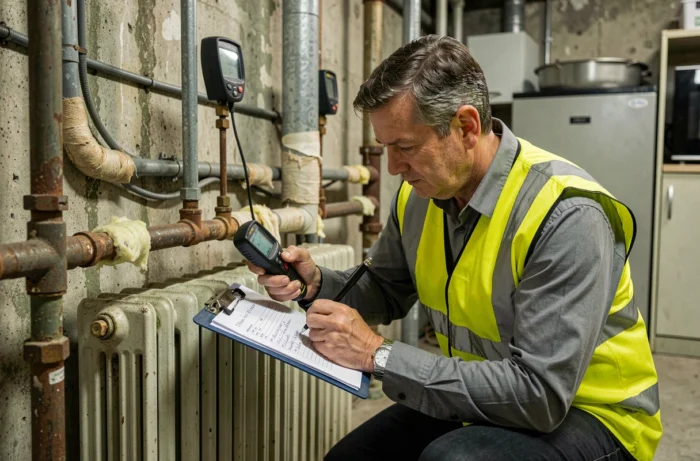
Work fund and financing of the energy diagnosis in co-ownership
The work fund, contributed to each year by the co-owners, is used in particular to finance the collective DPE and the energy audit. The property manager must ensure that the fund is sufficiently provisioned to cover these expenses without calling for exceptional funds.
In practice, the cost of a collective DPE varies depending on the size of the building and the complexity of the installations. For an energy audit, the bill is higher. The property manager should seek multiple quotes and present them to the council before placing the order.
- The work fund must be sufficiently filled to absorb the diagnostic costs without blocking the current cash flow of the co-ownership
- Aids such as MaPrimeRénov’ Copropriétés can cover part of the renovation work that follows the diagnosis, but not the diagnosis itself in most cases
- The property manager must anticipate the necessary calls for funds so that the voted works can start without delay due to a lack of financing
The financial management of the energy diagnosis is an integral part of the property manager’s mandate. A diagnosis ordered too late or poorly budgeted delays the entire renovation cycle.
The property manager who masters this complete chain, from collective DPE to the vote on the works through financing, secures the co-ownership on a regulatory and asset level. Regulatory deadlines leave no room for improvisation, and this is precisely where the competence of the property manager makes the difference between a co-ownership that moves forward and one that accumulates delays.