The development of a baby during its first two years relies on neurological mechanisms whose speed has no equivalent in the rest of life. The brain forms the majority of its synaptic connections during this time, making every daily interaction, every care routine, and every rest period crucial for what follows. Supporting this process does not require sophisticated equipment, but rather a precise understanding of a few fundamental levers.
Infant Crying: Decoding a Signal Before Calming
Crying is the baby’s first communication tool. Before trying to stop it, it is useful to distinguish its main causes: hunger, thermal discomfort, fatigue, need for contact, or pain.
An infant who brings their fists to their mouth and turns their head generally signals hunger. Sharp, sudden cries accompanied by legs drawn up to the abdomen indicate digestive discomfort. Identifying the type of cry allows for a quicker and more accurate response, which reduces the duration of episodes over the weeks.
Parents can find additional references on the bebemagique.fr website for babies, especially to refine their reading of the infant’s bodily signals.
Responding to cries within a reasonable time does not create “bad habits.” Research in developmental psychology shows that parental responsiveness during the first months strengthens the child’s sense of security, which is the foundation of their future autonomy.

Baby Sleep: Short Cycles and Sleeping Environment
Infant sleep operates in short cycles of about 50 minutes, very different from adult cycles. Between two cycles, the baby goes through a light sleep phase during which they may stir, open their eyes, or make sounds without being fully awake.
Intervening systematically at this moment risks waking them completely. Waiting a few moments before picking them up gives them the chance to enter a new cycle.
Safe Sleeping Conditions
- Put the baby to sleep on their back, on a firm and flat mattress, without a pillow, blanket, or bumper, in accordance with recommendations for preventing sudden infant death syndrome
- Maintain the room temperature around 18 to 20 degrees, favoring a sleep sack suitable for the season rather than a blanket
- Have the baby sleep in the parents’ room (but in their own bed) during the first months, a setup associated with easier monitoring of micro-awakenings
The regularity of bedtime matters more than the duration of a ritual. A simple sequence (bath, meal, lullaby or soft words) repeated every evening helps the infant anticipate the transition to sleep.
Screen Time Before Age 3: A Regulatory Ban Now in France
Since the decree of June 27, 2025, published in the Official Journal on July 2, 2025, the national charter for the reception of young children explicitly prohibits the exposure of children under 3 years old to any screen in all childcare structures (nurseries, micro-nurseries, childminders). This ban also covers the mere background noise of a television turned on in the room.
This tightening marks a break from previous formulations, which merely “discouraged” screens. Official prevention documents (health record, pages from the National Education) now classify screens as “prohibited before age 3.”
Concrete Application at Home
The ban only legally applies to childcare structures, not to the family home. However, official guidelines suggest that parents protect three specific moments of the day: waking up, mealtimes, and the hour before bedtime.
Removing screens during these times protects the transition phases when the baby’s brain is particularly receptive to human interactions. Having a meal in front of a screen reduces verbal exchanges between parent and child, which can slow down language acquisition.
Verbal Interactions and Sensory Awakening of the Infant
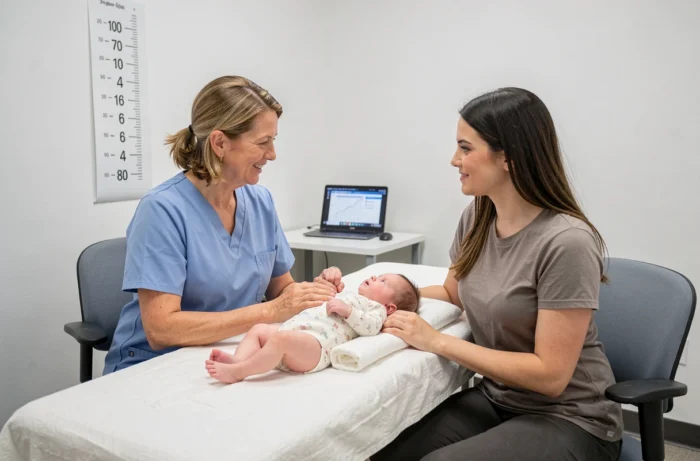
Oral language directed at the baby remains the most documented lever to support their cognitive development. Talking to the infant while looking at them, commenting on daily actions (dressing, changing, feeding), and responding to their vocalizations stimulate the construction of neural networks related to language.
Quality outweighs quantity. A short conversation, with pauses allowing the baby time to “respond” with a coo or movement, is better than a continuous stream of words without real interaction.
Some Age-Appropriate Awakening Practices
- Before 4 months: skin-to-skin contact, visual contrasts (black and white), and soft sounds (voice, lullabies) are sufficient to nourish early sensory learning
- From 4 to 8 months: voluntary grasping appears, offering objects of varied textures (fabric, smooth wood, soft rings) encourages hand-eye coordination
- From 8 to 12 months: the baby begins to understand object permanence, simple peek-a-boo games and cardboard books support this acquisition
Sensory awakening does not require specialized toys. Everyday objects (wooden spoon, stacking cup, box to open and close) often provide a richness of manipulation superior to that of an electronic toy.
The first months of a child’s life lay foundations whose effects can be measured over the long term. Protecting sleep, responding to cries with discernment, talking to the baby in real situations, and limiting passive screen exposure form a base that every parent can establish without special equipment, simply by adjusting their daily routines.