
The telephone code +49 designates Germany in the international numbering plan. This prefix, which is dialed before any German number from abroad, was not chosen at random. It stems from a geographical logic established by the International Telecommunication Union (ITU) during the 20th century, where each major region of the world was assigned a range of country codes.
Numbering zone +4: why Germany shares this prefix with its neighbors
The E.164 numbering plan, administered by the ITU, divides the world into numbered zones from 1 to 9. The +4 zone covers part of continental Europe. It includes the United Kingdom (+44), Denmark (+45), Sweden (+46), Norway (+47), Poland (+48), and Germany (+49).
This regional distribution explains why geographically close countries share a common first digit. France, with its +33, belongs to the +3 zone, alongside the Netherlands (+31), Belgium (+32), and Spain (+34). To better understand the origin of the 49 code in Germany, one must trace back to this structuring by continental blocks decided long before the mobile phone era.
The digit 9 in +49 has no symbolic meaning. It simply corresponds to the last available position in the +4x range when Germany received its code. Assignments were made progressively, in line with the memberships and technical needs of each country.

Code +49 and German reunification: a single code for two networks
Before the reunification in 1990, West Germany was already using +49. East Germany, the GDR, had its own code: +37. This code disappeared after the fall of the Wall when East German telephone infrastructures were absorbed by the West German network.
+49 became the unique code for reunified Germany. This transition required a complete overhaul of the internal numbering plan, with the integration of new regional codes for cities in the former GDR (East Berlin, Leipzig, Dresden). The +37, now freed, was subsequently reallocated by the ITU to other countries.
This technical merger remains a textbook case in the history of telecommunications. It illustrates how a country code, which seems innocuous, actually bears the marks of political divisions and major geopolitical developments.
Dialing a German number from France: regional code and mobile format
To call a contact in Germany from France, the sequence follows a precise logic. The international format requires replacing the initial zero of the local number with the country code.
- From a French landline or mobile, dial +49 followed by the regional code (without the zero) and then the local number. Example for Berlin: +49 30 followed by the number.
- For a German mobile phone, dial +49 followed directly by the mobile number (without the initial zero). German mobile numbers generally start with 15, 16, or 17.
- The prefix 00 replaces the + sign on traditional landlines. Dialing 0049 is exactly the same as +49.
German regional codes vary in length. Berlin uses 30 (two digits), Munich 89, Hamburg 40. Smaller cities have codes that are three, four, or five digits long. The larger the city, the shorter the regional code.
Difference between landline and mobile calls to Germany
For a call to a German landline, the regional code is essential. It identifies the geographical area of the contact. For a call to a mobile, this regional code does not exist: the number starts directly with an operator prefix (015x, 016x, 017x).
From a French mobile in the European Union, calls to Germany are charged at the “regulated roaming” rate if you are physically in an EU country. However, calling a German number from mainland France remains a classic international call, subject to your operator’s pricing conditions.
E.164 format and +49: what the + sign before the code means
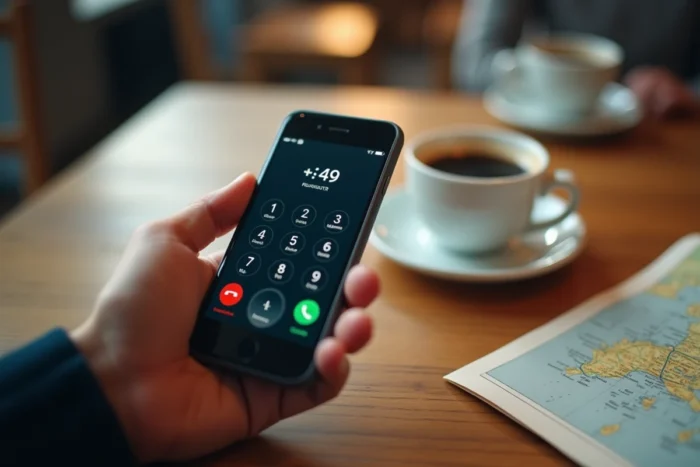
The + sign preceding 49 is not just a visual shortcut. It represents the international exit prefix, which is the sequence of digits to dial to leave the national telephone network and access the international network.
This exit prefix varies by country. In France and most European countries, it is 00. In the United States, it is 011. The + sign was introduced as a universal notation to avoid this confusion: a mobile phone automatically converts the + into the appropriate exit prefix for the country it is in.
The E.164 standard, defined by the ITU, governs this notation. It sets the maximum length of an international number (country code + national number) and ensures that each number is unique worldwide. +49 fits within this standardized framework, just like the French +33 or the North American +1.
Germany has retained its +49 code without interruption since reunification. Contrary to what is sometimes suggested by the confusion between 0049 and +49, both notations strictly refer to the same thing: an international call to the German telephone network. The only difference lies in the terminal used, with a mobile interpreting the + where a landline requires the manual entry of 00.