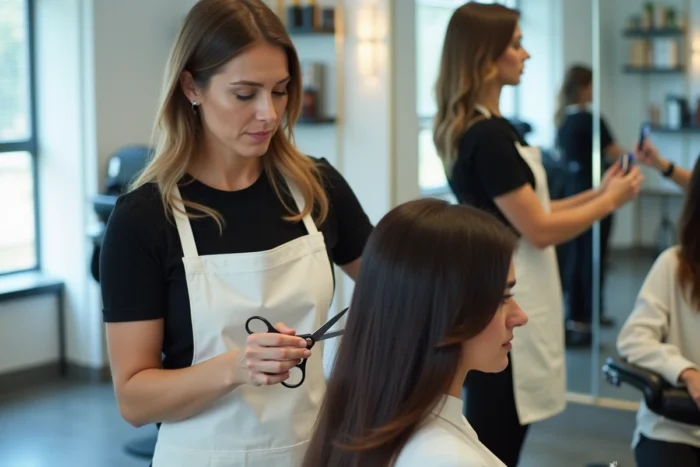
Thinning long hair changes the distribution of volume across the entire hairstyle, but the result depends on parameters that are rarely compared: hair texture, tool used, area worked on. Before making an appointment or picking up sculpting scissors, some technical distinctions deserve careful examination.
Thinning, layering, and sculpted cuts on long hair: what changes concretely
Consumer hair articles often use these three terms interchangeably. This confusion leads some clients to request thinning when they actually want layering, or vice versa. The difference lies in the cutting area and the effect achieved in the lengths.
| Technique | Area of intervention | Effect on volume | Impact on ends |
|---|---|---|---|
| Thinning | Inside the strands (mid-lengths and ends) | Reduces bulk without altering the overall shape | Finer ends, sometimes more fragile |
| Layering | Outer layer (strands shortened in steps) | Creates movement and redistributes volume | Intact ends on long layers |
| Sculpted cut (combined) | Both areas | Marked lightening with structured shape | Variable depending on the intensity of each technique |
A cut can be solely layered, solely thinned, or combine both. On long, thick hair, thinning alone lightens the bulk but maintains full length. Layering alone redistributes weight without thinning the strands.
Understanding this distinction allows for a precise request to the hairdresser, reducing the risk of disappointment. You can also check the benefits of thinning long hair on Zaturelle to delve into the advantages and limitations of each approach.

Thinning fine or thick hair: two opposing results
Hair texture determines the result more than any other variable. Light thinning on thick hair produces a welcome lightness and movement in the lengths. The same action on fine hair can give an impression of sparse hair, especially at the ends.
Thick and dense hair
Thinning removes weight from the bulk, making styling easier and reducing drying time. The lengths retain their visual density because the number of hairs per strand remains sufficient to maintain a full appearance. On thick hair, thinning increases in intensity without visible risk.
Fine and flat hair
The problem is the opposite. Each strand contains fewer hairs to begin with. Thinning further reduces this amount, and thinned ends on fine hair appear transparent within a few weeks. Regrowth also creates an uneven volume effect between the thinned parts and those that grow back at full thickness.
For fine hair lacking movement, light layering on the upper layers redistributes volume without sacrificing density at the ends. In contrast, deep thinning in the lengths should be avoided.
Thinning long hair at home: technical mistakes to know
At-home thinning is gaining ground, driven by online tutorials and the availability of sculpting scissors. The risks are real, and the results are rarely comparable to salon work.
- Inappropriate scissors: sewing or office scissors crush the hair fiber instead of cutting it. Sharp hairdressing scissors (straight or thinning) are the minimum for a clean result.
- Cutting too high in the strand: thinning less than ten centimeters from the root creates short regrowth that stands up and adds volume exactly where one wanted to remove it.
- Lack of visibility at the back: without a mirror setup or external help, the occipital area is often worked asymmetrically, which is noticeable as soon as the hair is tied back.
- Uniform thinning all over the head: a hairdresser adjusts the intensity area by area. Identical thinning everywhere flattens the top of the head while hollowing out the ends.
The most underestimated risk remains the cumulative effect. An initial at-home thinning may seem acceptable, but repeating the operation every two months eventually fragments the lengths. The hair loses its shape, and the only possible correction is then to cut it back significantly.
Lunar calendar and thinning: what enthusiasts monitor
Cutting according to the lunar calendar remains popular in hair care routines. Those who follow this method plan their thinning according to the moon phase, particularly during the waning phase.
The waning moon is said to slow regrowth according to this approach, which prolongs the effect of thinning. Conversely, cutting during the waxing moon or at the new moon would promote faster and denser regrowth. No scientific study confirms these effects on human hair, but the practice persists among many hairdressers and individuals.
For those who place importance on it, a hair lunar calendar allows for tracking the days of the waning moon each month. Thinning done on these dates would yield a more lasting result on the lengths.
Aftercare following thinning: protecting lightened ends
Thinned ends are mechanically more vulnerable than full ends. The surface of each strand is reduced, which exposes the fiber more to aggressions (heat, friction, coloring).
A leave-in treatment applied to the lengths after each wash limits breakage. Light vegetable oils (jojoba, argan) coat the ends without weighing down the hair. Using a hairdryer on a moderate temperature also preserves the hold of the thinning for longer.
A well-executed thinning only requires refreshing every three to four months. Returning to the salon (or scissors) more frequently for re-thinning often indicates an initial action that was too pronounced or hair that was not suited for this technique.
The choice between thinning, layering, or a combination of both primarily depends on the natural density of the hair and the desired visual result. Asking the right question to your hairdresser means naming the desired technique rather than simply asking to “lighten”.