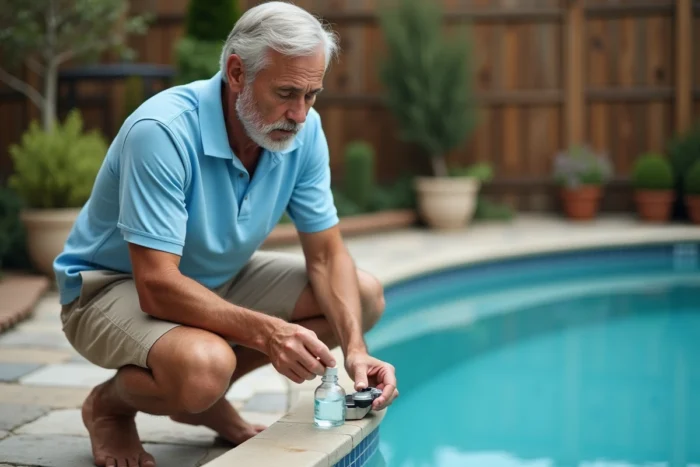
We pour the clarifier a bit too quickly, without re-reading the label, and the next morning the pool shows a milkiness thicker than before the treatment. Many pool owners instinctively add a second product to compensate. This is exactly what you should not do when you have added too much clarifier to your pool.
Clogging of the filter after over-dosing with clarifier: the real risk
Competing articles mainly discuss the appearance of the water. In practice, the most costly problem is not the cloudy water, but the filter. An excess of clarifier clumps micro-particles into larger bundles, and these bundles come to saturate the filter media well beyond its normal capacity.
With a sand or glass filter, the pressure on the manometer rises quickly. A prolonged backwash is usually enough to clear the media. The situation is more delicate with a cartridge or pleated paper filter.
Several manufacturers now indicate in their manuals that over-dosing with clarifier can permanently clog a cartridge to the point of needing replacement, rather than just rinsing it. Replacing a cartridge is significantly more expensive than simply washing a sand filter. If you have a cartridge filter, check its condition as soon as you notice the over-dosing, even before restarting filtration.
There are also detailed feedback on the subject of too much clarifier in my pool on Habitat Solutions, particularly regarding whether or not to drain after an excess.
Clearing cloudy water without draining the pool
In the current context of water restrictions and calls to limit pool drainings, emptying the pool for an over-dose of clarifier is a last resort solution. You can almost always recover the water by following a precise protocol.
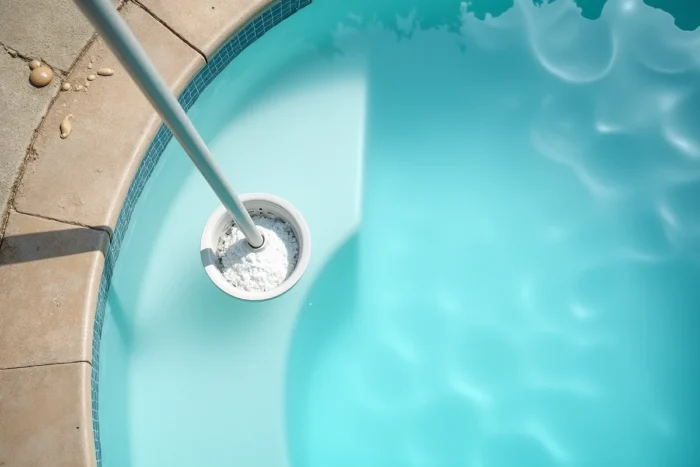
Steps to recover after an excess of clarifier
- Stop any addition of chemical products: no flocculant, no algaecide, no second clarifier. Each additional product complicates the water balance and can create new undesirable reactions.
- Clean the filter immediately: complete backwash for a sand filter, careful rinsing or replacement for a cartridge. If the filter remains loaded, filtration is useless.
- Restart filtration continuously for at least 24 to 48 hours. The clarifier needs time for the aggregates to be captured by the clean filter media.
- Suction the deposits at the bottom of the pool slowly, in “drain” position if possible, to avoid resuspending the particles in the water.
- Check the pH and disinfectant level (chlorine or bromine) after stabilization. An out-of-range pH makes the clarifier even less effective and maintains the milky appearance.
If the water remains milky after 48 hours of continuous filtration with a clean filter, the problem is probably not solely related to the clarifier.
Water still milky after 48 hours: look for the real cause
We often fall into a classic trap: we blame the over-dosing of clarifier, while the problem is multifactorial. Field professionals regularly observe that excess clarifier is rarely the sole cause of water that refuses to clear up.
Three parameters deserve serious analysis if turbidity persists:
Unbalanced TAC and pH
A TAC that is too low or too high prevents the pH from stabilizing. The clarifier works within a precise pH range. If the pH drifts, the agglomerated particles redisperse instead of being filtered. Before repurchasing clarifier or another treatment product, correct the TAC and then adjust the pH.
Excessive stabilizer level
An overly concentrated stabilizer (cyanuric acid) blocks the action of chlorine. The water appears correctly disinfected on the test strip, but the active free chlorine is actually insufficient. Microscopic algae and organic matter persist, maintaining the cloudy appearance. In this case, no amount of clarifier will solve the problem.
Feedback varies on this point, but most pool professionals recommend a complete water analysis at a specialized store or laboratory as soon as turbidity exceeds 48 hours. Some parameters like stabilizer are not easily measured with standard test strips.
Undersized filtration
A filtration system that is too small for the pool volume will never be able to capture the aggregates produced by the clarifier, even when properly dosed. After an over-dose, this limitation becomes even more apparent. Check that your pump’s flow rate matches your pool’s volume and that the daily filtration time is sufficient, especially in summer when the water temperature rises.
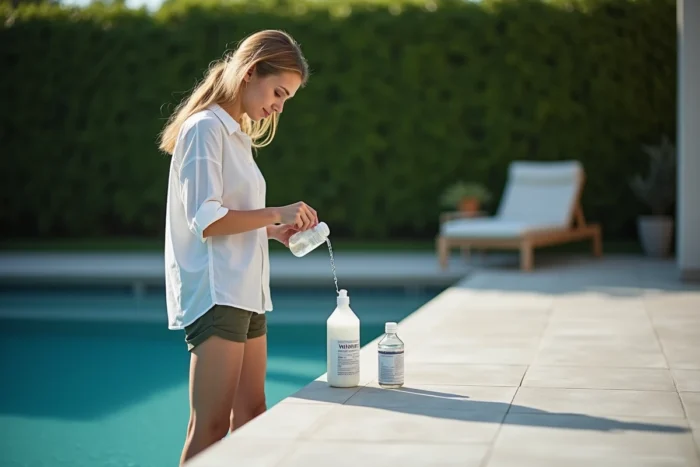
Clarifier and flocculant: do not confuse the recovery
A common mistake is to add flocculant to “compensate” for an excess of clarifier. These two products follow opposite logics. The clarifier clumps fine particles so that the filter can capture them. The flocculant, on the other hand, creates heavier clumps that fall to the bottom of the pool and must be manually vacuumed.
Mixing the two after an over-dose often results in even cloudier water, with gelatinous deposits that are difficult to vacuum. If you have a cartridge filter, flocculant is also not recommended as it clogs the pleated paper almost irreversibly.
In the case of over-dosing with clarifier, we stick to the simple protocol: clean filter, long filtration, patience. The flocculant only comes into play later, and only on a sand filter, if the water does not improve after several days and after correcting the chemical parameters.
Preventing over-dosing with clarifier for the pool
Most over-doses come from a miscalculation of the pool volume. We estimate “approximately” the capacity, we pour the clarifier by eye, and the dose far exceeds what the label recommends.
Taking five minutes to recalculate the actual volume of the pool (length x width x average depth) avoids the majority of incidents. Pouring the clarifier with a graduated measuring cup, rather than directly from the container, also limits excesses.
Over-dosing with clarifier can be corrected in the vast majority of cases without draining, provided you do not panic and do not stack chemical products. Clean filter, continuous filtration, verified parameters: these three actions are almost always enough to restore clear water in a few days.