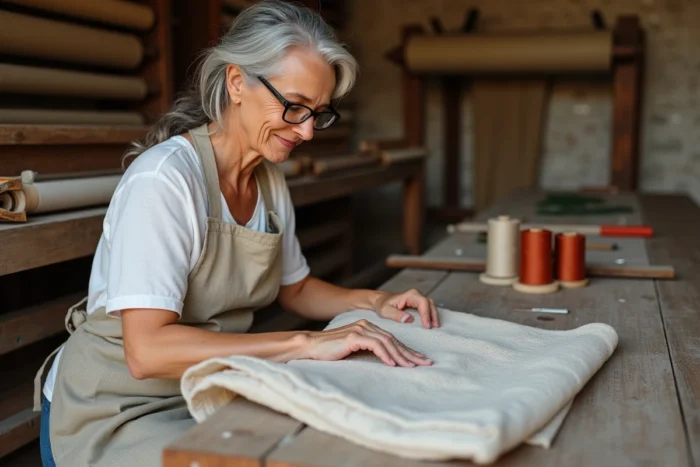
The word textile comes from the Latin texere, meaning to weave. Its definition encompasses any flexible material made of fibers, whether woven, knitted, or non-woven. Behind this familiar term lies an industry in full transformation, balancing a millennia-old artisanal heritage with a European regulatory framework still under construction.
Textile fiber and manufacturing process: what distinguishes a fabric from a non-woven
A common confusion is using “textile” and “fabric” as synonyms. A fabric is a textile obtained by the perpendicular crossing of two sets of threads on a loom. A knit, on the other hand, results from the interlacing of loops of thread. A non-woven, finally, assembles fibers through mechanical, thermal, or chemical processes, without going through traditional spinning.
The fiber remains the common denominator. It can be natural (cotton, wool, linen, silk), artificial (viscose, lyocell, derived from transformed cellulose), or synthetic (polyester, polyamide, elastane, derived from petrochemicals). The choice of fiber determines the hand feel, durability, and behavior of the final textile when washed, worn, or exposed to heat.
To understand what textile is according to Web United, it is essential to remember this distinction between the raw material (the fiber), the yarn produced by spinning, and the fabric obtained through the chosen process. Each step influences the properties of the finished product.
Origin and history of textiles: from Neolithic linen to synthetic fibers
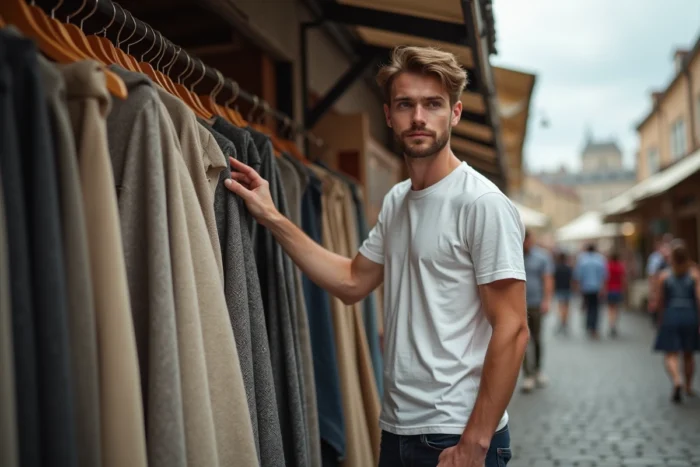
The oldest traces of processed fibers date back to prehistory, with fragments of linen found in archaeological sites in the Near East. Cotton appears in the Indus Valley, silk in China, and wool in Mesopotamia. Each civilization developed its spinning and weaving techniques based on the fibers available locally.
For millennia, textile manufacturing remained artisanal. The manual loom, spindle, and distaff constituted the basic equipment. The industrial revolution shifted production from home to factory, with the advent of the mechanical loom and spinning machine. Spinning and weaving became concentrated in industrial hubs, particularly in England, northern France, and Catalonia.
In the twentieth century, synthetic fibers changed the game. Polyester and polyamide allowed for the production of cheaper, more durable clothing, but dependent on petroleum. This dual origin, natural and synthetic, still structures the global textile industry today.
Everyday uses of textiles: far beyond clothing
Clothing represents the most visible use, but textiles cover sectors as varied as medical, construction, and automotive. Non-wovens are used in surgical masks, geotextiles stabilize soils in public works, and technical fabrics reinforce aerospace composite parts.
At home, textiles are everywhere:
- Bedding and bath linens, where cotton and linen dominate for their absorbency
- Upholstery (curtains, sofa coverings, rugs), with materials chosen for their abrasion resistance
- Thermal and acoustic insulation, where recycled fibers are gradually replacing fiberglass in certain applications
In sports, technical textiles made from synthetic fibers manage sweat evacuation and muscle compression. Each use imposes different performance criteria, which explains the proliferation of materials and finishing treatments.

Environmental labeling and textile regulation in France
The French regulatory framework is evolving rapidly. Since September 6, 2025, a decree and an order define the methods for calculating the environmental cost of clothing textile products and the associated labeling. This system remains voluntary for now, but it lays the groundwork for structured environmental labeling.
The method is subject to an open consultation with the industry, with possible regulatory changes by the end of 2026 and a potentially modified framework in the second half of 2027. Meanwhile, the future European Digital Product Passport is expected to make digital environmental labeling mandatory for textile products.
Another deadline to watch: the ban on the destruction of unsold textiles comes into effect on July 19, 2026. This measure pushes brands to rethink their stock management and develop reuse or recycling circuits. Field feedback varies on this point: some brands have been anticipating for several seasons, while others struggle to adapt their logistics.
Traceability of fibers and labeling
Textile labeling remains a technical subject. The fiber composition must appear on every product sold in the European Union, with tolerance thresholds for blended fibers. The available data does not yet allow for conclusions about the actual effectiveness of these labels in guiding consumer choice, but the transition to the digital passport could change the game.
- Fiber composition expressed as a percentage, in descending order
- Country of manufacture mentioned voluntarily (no uniform European obligation on this point)
- Care instructions standardized by pictograms
Circular textiles and fiber recycling: where the industry stands
Textile recycling remains a technical challenge. Recycling a pure synthetic fiber is simpler than separating a cotton-polyester blend, which constitutes a significant portion of produced garments. Chemical recycling technologies are advancing, but their large-scale industrial deployment takes time.
In France, the eco-organization Refashion collects used textiles. Some are reused, while others are shredded to produce industrial rags or insulation. The fraction actually transformed into new fiber of equivalent quality remains minority. In contrast, the second-hand market is experiencing rapid growth, driven by digital platforms and a change in consumer perception.
The textile industry finds itself at a crossroads between environmental regulation, changing uses, and the technical limits of recycling. Upcoming French and European deadlines, particularly regarding the digital passport and environmental labeling, will determine the speed at which these transformations materialize on store shelves and in workshops.