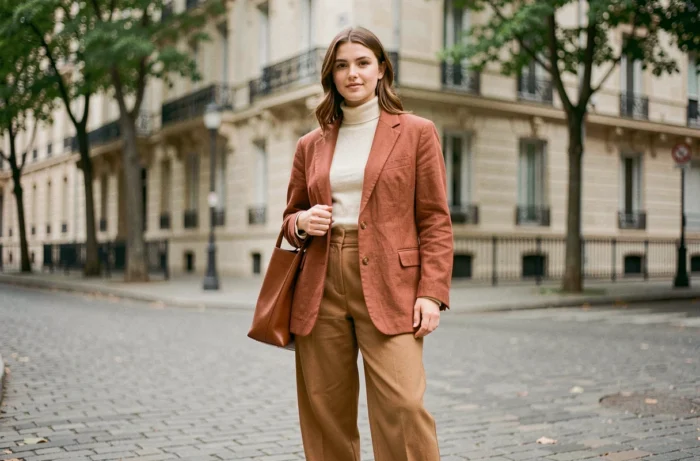
When you open your closet in the middle of the transitional season, the question isn’t about replacing everything. The fashion trends for 2024 are built around pieces you already own, rearranged with bold colors, assertive patterns, and a few repurposed basics. The challenge isn’t to follow a runway show, but to extract what works in everyday life, on the street, at the office, in the evening.
Saturated colors and contrasts: creating a cohesive outfit
Cherry red, seen on the runways of Gucci and Saint Laurent, dominates the season. It’s found on bags, shoes, and structured dresses. Its effectiveness lies in its versatility: it effortlessly enhances a total black look.
Cobalt blue and emerald green complete this palette. In practice, one saturated piece is enough to anchor a look. Two bright colors in the same outfit work as long as the rest remains neutral (beige, heather gray, off-white). Three bright colors, and you slip into costume territory.
We spotted on the Fashion Boobies fashion site combinations that illustrate this principle well: a strong colored piece, a sober base, a discreet accessory. This ratio remains the most reliable for a bold style without visual overload.
- Cherry red or deep burgundy as the statement piece (jacket, dress, wide pants)
- Cobalt blue reserved for accessories or shirts, easier to balance
- Emerald green in knit or velvet for the autumn-winter months
- Neutral base is mandatory: contrast only works if the background remains calm
Patterns and layering: what distinguishes personal style from a uniform
Oversized floral patterns and wide stripes return every spring. The difference in 2024 is layering. You wear a patterned shirt under a solid sleeveless sweater, or a printed dress with a structured blazer on top.
Layering creates uniqueness without buying new pieces. An open trench over a graphic top, a knit vest over a flowy dress: these are combinations you won’t see in fast fashion catalogs, precisely because they require a bit of thought.
Two common mistakes to avoid
The first: layering identical textures. Two layers of fine cotton fall flat. It’s better to contrast a matte fabric (linen, brushed cotton) with a shiny or textured fabric (satin, corduroy).
The second: multiplying patterns without hierarchy. One strong pattern per outfit, the rest flat, is the simplest and most effective rule. Designers who master layering (Rundholz, Dries Van Noten) all apply this principle of contrast between printed surfaces and solid surfaces.
Street style and sportswear: adapting the codes without falling into gym attire
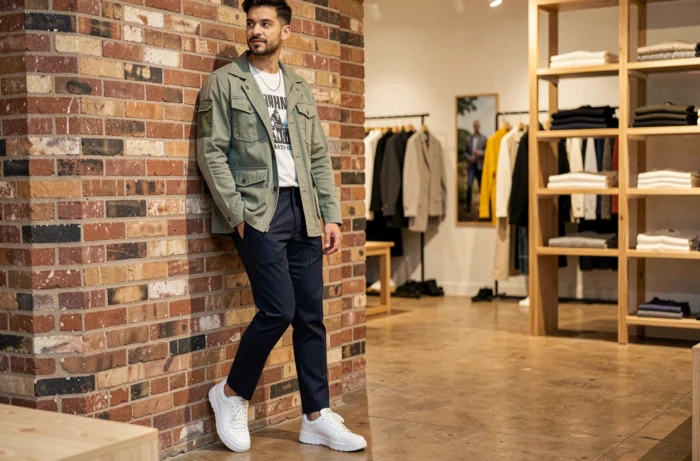
Sportswear continues to establish itself outside of gyms. Football jerseys, technical sneakers, hooded windbreakers: these pieces have been circulating on the street for several seasons. Their adoption in 2024 involves a more controlled mix with dressier clothes.
In practical terms, tailored pants with sneakers and a technical jacket work. A full tracksuit with a cap and flip-flops is a locker room outfit, not street style. The mix works when one sportswear piece is paired with two more formal pieces.
The case of independent creators
Small creators and independent brands are gaining ground in clothing choices. The generation buying today seeks pieces that aren’t found everywhere. This doesn’t mean buying expensive: returns vary on this point, but private sales, outlets, and second-hand options make these pieces more accessible than before.
European regulation on unsold textiles: what it means for consumers
The Ecodesign for Sustainable Products Regulation (ESPR), which came into effect in July 2024, gradually prohibits large companies from destroying unsold clothing, shoes, and accessories. Large companies will be affected starting July 2026, with medium-sized companies following in 2030.
For those seeking a unique style, this regulation has a direct effect. No more unsold stock redirected to resale, donation, and reuse means more accessible designer pieces in second-hand or clearance sales. Brands must also publish each year the quantity of unsold products destroyed and the associated reasons, which encourages a reduction in overproduction.
In practice, there are already more end-of-line items and capsule collections on resale platforms. This is a concrete opportunity to access bold pieces at reduced prices, those that wouldn’t have found buyers in stores but make a significant difference in a thoughtfully constructed wardrobe.
The fashion trends for 2024 are not just a list of colors or silhouettes. They reflect a change in approach: less accumulation, more thoughtful combinations, and broader access to standout clothing thanks to the new rules of the European market.