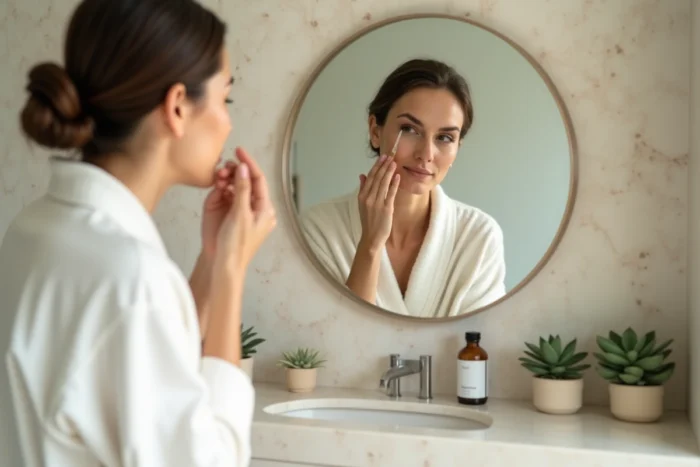
The natural cosmetics market is going through a period of tension. Brands claim to offer skin-friendly formulations while incorporating increasingly powerful active ingredients (retinol, concentrated vitamin C, PDRN) in ranges that still claim to be gentle. This contradiction redefines what it truly means to care for your skin with natural products.
Powerful Actives in Natural Cosmetics: A Paradox for Sensitive Skin
Performance has become the new language of beauty. Natural skincare brands no longer just offer simple vegetable oils or hydrosols. We now find glutathione, marine collagen, vitamin C serums, or plant-based retinol in ranges that bear a “natural” label.
The problem is that natural no longer necessarily means gentle. A natural serum concentrated with fruit acids can cause redness or disrupt the skin barrier just as much as a poorly formulated conventional product. Tolerance depends on concentration, overall formulation, and skin type, not just the botanical origin of an ingredient.
To adopt a natural beauty routine that truly respects the face, the question to ask is not “Is this product natural?” but “Is this treatment suitable for my skin’s sensitivity?”. A site like https://www.beautenature.net/ allows you to explore formulations designed with this skin compatibility logic rather than simple labeling.

Labels and Ingredient Traceability: What Certifications Don’t Tell You
Articles on natural beauty often recommend “looking for organic labels.” The advice is correct but incomplete. A label certifies a specification, not individual tolerance.
Certifications like Cosmos Organic or Ecocert guarantee a minimum percentage of naturally sourced ingredients and the exclusion of certain synthetic substances. However, they do not control the concentration of irritating actives (some natural acids, certain essential oils) or the product’s suitability for a specific skin type.
What Consumers Now Demand
Expectations are evolving beyond just the logo on the packaging. Field feedback shows a growing demand for:
- Real traceability of ingredients, from field to bottle, with information on geographical origin and cultivation methods
- Refillable or reusable packaging that reduces environmental impact without compromising product preservation
- Readable and short formulas, where each component has an identifiable function, far from lengthy INCI lists
This demand for consistency between brand messaging and the actual impact of the product goes far beyond the reflex of “I choose organic.” It requires reading labels with a critical eye, even on natural cosmetics.
Natural Beauty Routine for the Face: Cleansing and Hydration Without Overload
Skinimalism (or skip-care) proposes a radical approach: reduce the number of products to focus on the fundamental needs of the skin. Two steps form the foundation of a functional natural routine.
Gentle Cleansing Without Harsh Surfactants
An effective facial cleanse does not require abundant foam. Makeup-removing vegetable oils dissolve sebum and impurities without stripping the hydrolipidic film. Jojoba oil, for example, has a lipid composition similar to human sebum, which limits the risk of reaction.
Double cleansing (oil followed by a gentle water-based cleanser) remains relevant for made-up skin. For others, a single pass with a suitable product is often sufficient. Multiplying cleansing steps weakens the skin barrier rather than strengthening it.
Targeted Hydration with Simple Ingredients
A moisturizing cream or oil applied to clean, slightly damp skin constitutes the second pillar. Hemp, argan, or rosehip oils offer varied fatty acid profiles, suitable for different skin types.
The serum, often presented as a mandatory step, is not always necessary. On skin that does not present a specific issue (spots, pronounced wrinkles, severe dehydration), a good natural moisturizing cream serves the same purpose. Adding a treatment without a real need increases the risk of incompatibility between products.

Decoding Natural Cosmetic Ingredients: Beyond Marketing
The mention of “based on” or “enriched with” on a packaging does not guarantee anything about the actual proportion of an active ingredient. A facial treatment can claim “with argan oil” while containing only a negligible fraction, drowned in excipients.
The position of an ingredient in the INCI list remains the most objective reading criterion. Actual concentrations are almost never communicated by manufacturers, and experiences vary greatly from person to person depending on skin type and the overall formulation of the treatment.
- Components listed in the first five of the INCI list represent the majority of the formula
- An active touted on the packaging but located at the end of the list is present in trace amounts
- Essential oils, even natural, are among the most common allergens in cosmetics and deserve special attention on reactive skin
- Natural preservatives (sorbic acid, tocopherol) have a shorter protection duration than their synthetic counterparts, which requires strict adherence to usage deadlines after opening
Reading a bottle of natural cosmetics requires the same level of attention as a conventional product. The difference lies not in the packaging but in the actual composition and the transparency of the manufacturer.
Building a natural beauty routine that respects the skin requires resisting two symmetrical temptations: the accumulation of products “because they are natural” and blind trust in a label. The INCI list, the position of actives in the formula, and observed reactions on one’s own skin provide more concrete references than a logo or a marketing claim.