The spring-summer 2026 silhouette breaks away from the fluid style that dominated previous seasons. The runways and trend reports converge towards sharp and architectural shapes: sculpted blazers, column dresses, wide but structured trousers. This shift towards garment construction alters the way to compose a look this season.
Structured silhouette spring-summer 2026: the return of architectural lines
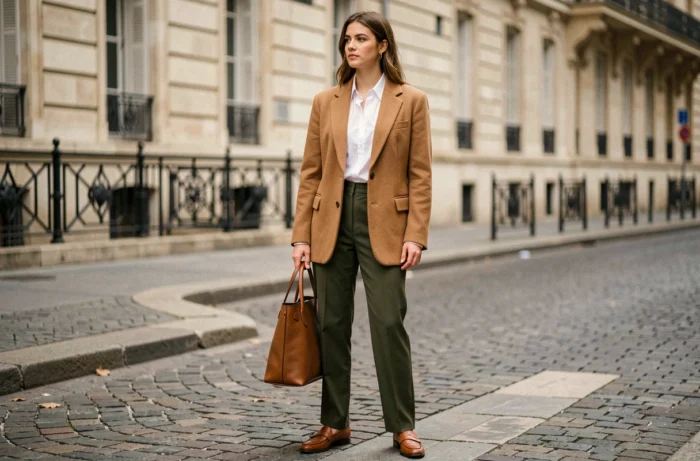
We observe a clear shift from the codes of the last two seasons. The ample draping gives way to defined shoulders, tailored darts, and controlled volumes. The blazer is no longer worn deconstructed: it returns with a sculpted shoulder, often slightly padded, in materials rigid enough to hold the shape without heavy lining.
The column dress, fitted at the bust and then straight to the ankle, stands out as the piece that encapsulates this choice. It works alone with a flat sandal or under a blazer for a more dressed-up style.
Wide trousers remain present, but the cut evolves. We move from a soft drape to a trouser with pronounced pleats and visible fabric structure. Structured linen, thick cotton, and blends with a touch of lightweight wool are the materials that achieve this result. For those who wish to discover fashion on Equivok, this approach to materials and cuts provides a concrete framework to guide choices this season.
Statement accessories: brooches, belts, and gloves as style leverage
Accessories become the main vector of personalization in 2026. Rather than renewing an entire wardrobe, the trend encourages investing in strong pieces that transform a basic outfit.
The brooch makes a marked comeback. Worn on a blazer lapel, on a shirt, or even directly on a turtleneck, it adds a maximalist dimension to a sober look. Voluminous models, in textured metal or adorned with colorful stones, are the most visible on runways and in buyers’ selections.
- Thick belts restructure the silhouette: worn over a column dress or high-waisted trousers, they define the waist and add a contrast of materials (grained leather, woven, patent).
- Short or mid-length gloves, in fine leather or knit, return as a full-fledged style accessory, not just as protection against the cold.
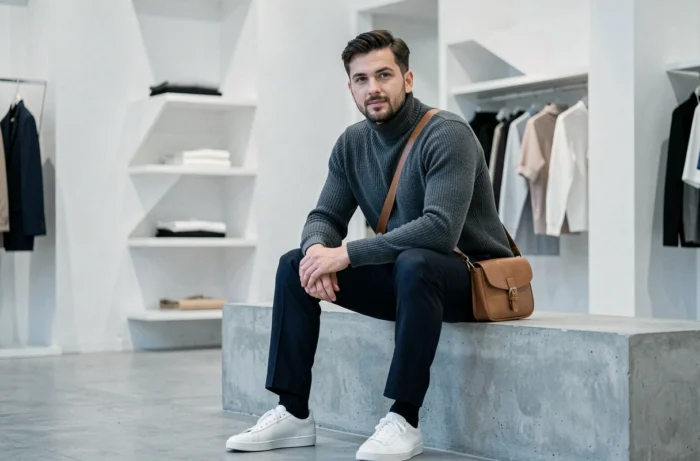
- Medium-sized bags with short straps replace micro-bags: the proportion becomes functional, without falling into the tote category.
This range of accessories allows for a sustainable wardrobe logic without sacrificing visual novelty. A structured blazer worn for three seasons completely changes its look with a different brooch or belt.
Temperate maximalism: saturated colors and patterns without excess
Quiet luxury, very present for several seasons, softens. We are not witnessing a raw return to the garish prints of the 2000s, but rather a more controlled maximalism. Saturated colors (deep burgundy, Klein blue, butter yellow) are worn in blocks, on a single strong piece, paired with neutral basics.
Prominent patterns coexist with solid pieces in the same look. A midi skirt with wide stripes pairs with a monochrome top. A printed trouser is toned down with a structured black blazer. The principle is simple: one expressive piece per outfit.
Pastel pink and camel remain safe bets for those who prefer a more discreet style, but this season, they benefit from being worn as a total look rather than in scattered touches. A camel trouser-shirt set, accessorized with a contrasting belt, creates a more assertive effect than a gradient mixed with gray.
Anti-fast fashion law and sustainable fashion: what changes concretely in 2026
The fashion trend for 2026 is not only seen on the runways. In France, the anti-fast fashion law introduces a penalty on non-sustainable clothing starting September 1, 2026. This regulatory framework is beginning to change the offerings of brands and purchasing habits.
Specifically, low-durability items (low-quality synthetic materials, fragile construction) will face financial penalties. For consumers, this reinforces the interest in investing in cuts and materials that last several seasons, exactly the structured style and durable accessories described above.
We recommend prioritizing pieces whose construction justifies the price: a blazer with real supportive seams, trousers whose fabric doesn’t pill after three washes, a solid metal brooch rather than a lightweight alloy. Sustainable fashion becomes a criterion of style as much as a conviction.
Trendy shoes summer 2026: flat sandals, mules, and ballet flats
The structured garment style extends to the feet, but with a counterpoint of lightness. The flat sandal with wide straps dominates the season. It works well with the column dress as well as with pleated trousers.
The mule, open or closed, remains a relevant choice for a transition look from office to outdoors. Models with low block heels (a few centimeters) provide structure without compromising comfort. Ballet flats, with their strap over the instep, return in smooth or patent leather versions that pair well with midi skirts and cropped trousers.
The common point of these three types of shoes: clean lines and a solid color. Embellishments focus on the upper body (brooches, belts), while the footwear remains understated to balance the whole.
The 2026 season is summed up by a principle of composition rather than a list of mandatory pieces. A constructed silhouette, one or two strong accessories, a controlled palette, and materials chosen for durability create a framework flexible enough to adapt to each personal style.