The transformation of the North District of Villeneuve-Saint-Georges is not limited to facade renovations. This urban renewal program, selected as a national interest neighborhood under the NPNRU, involves significant operations that simultaneously affect the buildings, roadways, networks, and public facilities. Measuring its impact on safety and quality of life requires examining what is concretely changing on the ground, beyond institutional announcements.
Asbestos and PAH Diagnostics: Health Safety Before the First Pickaxe Strikes
Competitors often present urban renewal as a linear sequence of demolitions and reconstructions. The North District project reveals a more technical reality. A municipal order dated December 19, 2025 mandated asbestos/PAH sampling and analysis within the project perimeter, a clear signal that the preparatory phase now incorporates strict health safety constraints.
These diagnostics condition the continuation of the work. The presence of asbestos or polycyclic aromatic hydrocarbons in the soil or old buildings requires asbestos removal protocols, construction site confinements, and specific waste treatment channels. For residents, this means that the renovation in the North District of Villeneuve Saint Georges addresses health risks upfront, not improvising during the work.
This level of preparation distinguishes the NPNRU from a classic rehabilitation. It extends the timelines perceived by local residents, but it ensures that the delivered housing and redeveloped public spaces will not have residual contamination.
Roads and Mobility in Villeneuve-Saint-Georges: Active Construction Sites in 2025-2026
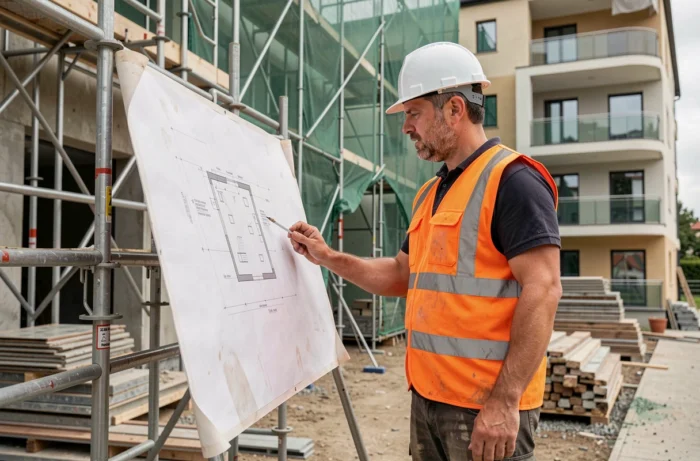
The transformation of the North District is not only taking place in the buildings. The traffic and parking orders published by the town hall throughout 2025 and early 2026 indicate a massive intervention in public space. Several network, roadway, and development companies are simultaneously working in the area.
How Road Works Change Daily Life
Saint-Exupéry Street had already been redone in 2014, with the reconstruction of the footbridge. The current phase goes further by restructuring pedestrian pathways, parking, and overall accessibility of the neighborhood.
| Intervention Area | Before Renovation | During/After Renovation |
|---|---|---|
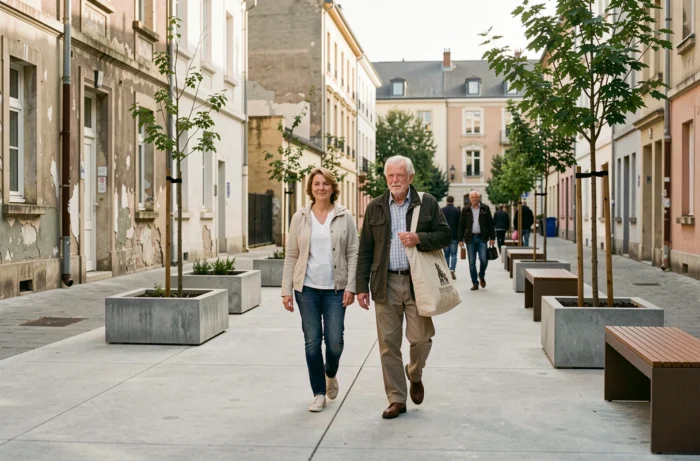
| Roads | Degraded road surfaces, narrow sidewalks | Complete refurbishment, widening of pedestrian pathways |
| Parking | Anarchic occupation, few organized spaces | Reorganization with ongoing regulation orders |
| Buried Networks | Aging pipelines | Replacement by specialized VRD companies |
| Soft Mobility | Almost non-existent | Integration of secure pathways |
Temporary constraints (detours, removal of parking spaces) weigh on the daily lives of residents. However, each order published corresponds to a measurable advance towards a restructured public space.
Public Safety and Urban Renewal: Two Converging Dynamics
Villeneuve-Saint-Georges is experiencing a broader security transformation than just the NPNRU. The municipal police have recently been in the media spotlight due to their intervention methods, with multiple complaints and a nationwide police crackdown reported by the national press.
This situation highlights a common paradox in neighborhoods undergoing renovation. The improvement of buildings and public spaces reduces certain insecurity factors (dark passages, degraded lobbies, areas without visibility). But it is not enough, on its own, to resolve tensions if the human and institutional dimension does not accompany the physical transformation.
What Renovation Concretely Changes in Terms of Security
- Residentialization of Buildings: access control to lobbies, elimination of unmonitored corners, enhanced lighting in common areas and surroundings
- Redesign of public spaces with better natural visibility (clearing sight lines, removal of blind walls)
- Creation or renovation of about ten public facilities (school group, gyms, daycare), which generate regular and diverse foot traffic in the neighborhood
- Restructuring of parking, which limits abandoned vehicles and informal occupation areas
These interventions fall under situational prevention. They do not replace a public safety policy, but they modify the physical environment in which problems manifest.

Housing and Requalification of the North District: Timeline and Financial Commitments
The prefiguration protocol signed on February 7, 2019 opened an eighteen-month reflection phase before the multi-year agreement. This agreement sets the financial commitments of the partners (ANRU, city, landlords, intercommunalities) and the work program concerning housing, facilities, and public spaces.
The Valophis Group, a social landlord present in the area, has organized public meetings to present the neighborhood’s transformation. Many residents attended these meetings, indicating that the expectation goes beyond the simple institutional framework.
What Remains to be Delivered
The phase of active work confirmed by the orders for 2025-2026 indicates that the program is not complete. The interventions on buried networks, roadways, and health diagnostics logically precede the delivery of rehabilitated housing and the finalization of landscaping.
The project combines partial demolitions, reconstructions, and heavy rehabilitations. This mixed approach avoids the trauma of a clean slate while allowing for a deep requalification of the existing housing stock.
The North District of Villeneuve-Saint-Georges illustrates what a NPNRU program produces when it goes beyond mere real estate rehabilitation. The asbestos diagnostics, simultaneous roadway works, and restructuring of public spaces form a coherent whole. The key takeaway: the municipal orders from late 2025 and early 2026 confirm that the construction site remains active and is progressing, with health and technical constraints shaping the future quality of life in the neighborhood.