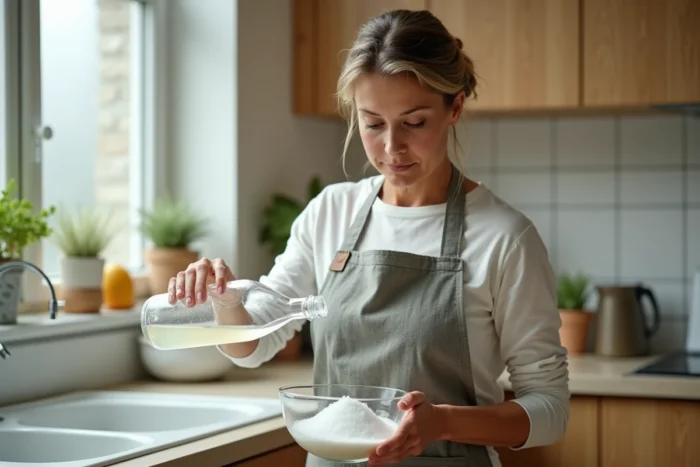
When you want to create a smoke effect for a home experiment, a little show for children, or an educational demonstration, the first instinct might be to look for smoke bombs or dry ice. However, baking soda, which is stored in the kitchen cupboard, can generate a spectacular gas release without combustion.
The chemical reaction involved does not produce smoke in the strict sense, but rather bubbling and a flow of CO₂ that visually mimics the desired effect, at room temperature and without the risk of burns.
Baking soda and vinegar reaction: what really happens in the container
Before pouring anything, it’s helpful to understand the mechanism. Baking soda (NaHCO₃) is a weak base. When it comes into contact with an acid like white vinegar (acetic acid), it forms sodium acetate, water, and carbon dioxide. It is this CO₂ that causes the bubbling and abundant foam often mistaken for smoke.
The CO₂ released is a colorless and odorless gas, heavier than air. It flows down the walls of the container and can be “poured” like an invisible liquid. This property is exploited to extinguish a candle without blowing it out, simply by tilting the container over the flame. The visual effect, especially in a slightly dim room, gives the impression that an invisible flow (a “smoke”) is descending on the flame.
For those who want to delve deeper into how to make smoke with baking soda by detailing each step, the logic remains the same: we play with the volume of CO₂ produced and the staging around it.
Concrete protocol for producing a smoke effect with baking soda at home
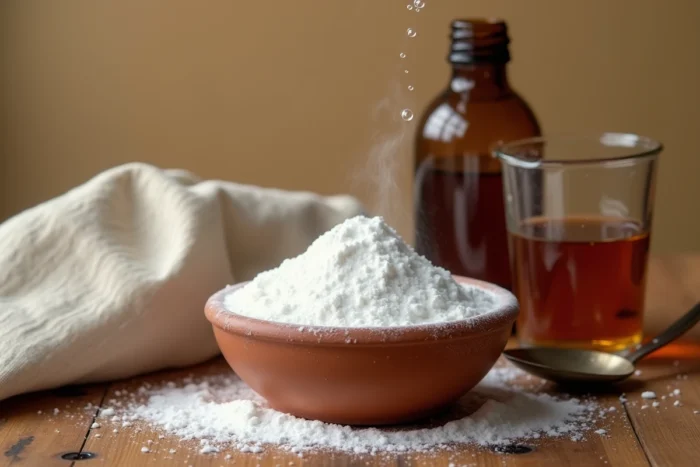
Let’s get practical. The materials fit in a shopping bag.
- A narrow-necked container (cut bottle, large glass, jar) to concentrate the gas release upwards
- White vinegar, about a bottom of a glass per trial
- Two to three tablespoons of food-grade baking soda
- Dish soap (a few drops) if you want to amplify the foam and make the effect more visual
- Food coloring (optional) to give a “volcano” or “potion” aspect to the demonstration
First, pour the vinegar into the container, add the dish soap and coloring, then introduce the baking soda all at once. The reaction is immediate: the foam overflows in a few seconds, simulating a plume of colored smoke.
Candle variant for an “invisible smoke” effect
To take it further, place a lit candle next to the container. Wait for the reaction to calm down (the CO₂ continues to accumulate at the bottom of the jar even after the bubbling has stopped). Then gently tilt the jar over the flame, without pouring any liquid. The gas, being heavier than air, flows over the candle and extinguishes it. The absence of visible breath makes the scene astonishing, especially for children.
Feedback varies on this point: depending on the size of the container and the amount of baking soda used, the volume of accumulated CO₂ may be insufficient to extinguish the candle on the first try. A jar of at least one liter is recommended to have a sufficient gas reserve.
Safety and limits of baking soda smoke indoors
It is sometimes said that this experiment is “safe.” This is generally true, but with some practical nuances.
The reaction occurs at room temperature, without flame or heat released. There is no risk of burns, no hot splashes. The CO₂ produced is not toxic in small amounts, but in a closed room, repeated and massive releases can deplete the air of oxygen. Ventilate the room between trials, especially if multiple demonstrations are conducted with excited children who want more.
Vinegar can splash if the baking soda is poured too quickly into a container that is too small. It irritates the eyes. Opting for a deep and wide container limits splashes.
What this method does not produce
We do not generate real smoke with baking soda and vinegar. There are no suspended particles or burnt smell. For video shoots or stage decor, this technique remains limited: the effect is primarily educational and playful. If you are looking for a thick mist visible over several meters, you need to turn to dry ice or a smoke machine.
Educational baking soda activity: adapting the staging according to the audience
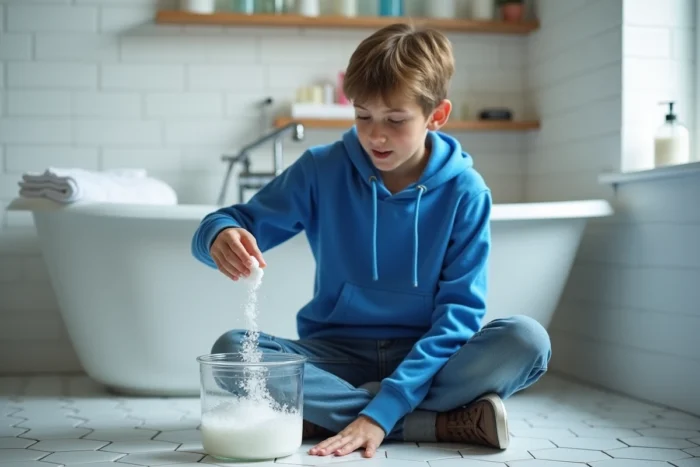
In recent years, experiments with the baking soda-vinegar volcano have become a common educational activity in children’s workshops. The educational interest is real: we observe an acid-base reaction, we talk about gas, pressure, density, without handling dangerous products.
For younger children, the “volcano” version works well. We mold a cone out of salt dough or papier-mâché around a bottle, pour the vinegar-baking soda mixture with red coloring, and the overflowing foam simulates an eruption. The addition of dish soap doubles the volume of foam produced.
For an older audience or in a school setting, the candle-extinguishing variant introduces physics concepts: why CO₂ sinks, why the flame goes out, what “heavier than air” means. You can extend this with a simple test: bring a lit match close to the jar to check that the gas is still present even after the bubbling has stopped.
- Volcano version: children from four years old, maximum visual effect, cleaning required (the coloring stains)
- Candle-extinguishing version: from seven to eight years old, supervised handling by an adult
- Foam race version: two jars side by side, comparing the proportions of baking soda-vinegar to see which overflows first
Food-grade baking soda and technical baking soda produce the same reaction. The technical one is cheaper and is sufficient for these experiments, as we do not consume the result.
Producing a smoke effect at home with baking soda remains a matter of simple chemistry and staging. The result will not rival a fog machine, but for a scientific demonstration, a creative afternoon, or a party activity, a few tablespoons of baking soda and a splash of vinegar are enough to captivate an audience.