
A preliminary declaration panel displayed on the site serves not only to inform the neighbors. It triggers the appeal period for third parties, set at two months by the urban planning code. An error on this panel, even minor in appearance, can prevent this period from running and expose the project to a late challenge.
Downloading a ready-to-print preliminary declaration panel template requires checking that each mandatory mention is included, in the correct format and with the correct references.
Errors on the preliminary declaration panel: what judges will sanction in 2026
Competitors detail the mandatory mentions at length, but few focus on how courts assess deviations. Since 2025, administrative case law has become stricter regarding so-called minor errors.
A rounded surface within a square meter, a truncated cadastral reference, or an approximate wording of the nature of the work is now sufficient for the judge to consider the information for third parties as incorrect. The direct consequence: the two-month appeal period does not start, even if the construction site is completed.
Downloading a free preliminary declaration panel template updated to these requirements helps avoid these pitfalls. The PDF file must reproduce word for word the titles from the urban planning code, without personal rephrasing.
| Type of error on the panel | Judicial assessment (trend 2025-2026) | Consequence on the appeal period |
|---|---|---|
| Rounded or approximate floor area | Considered incorrect information | The appeal period does not run |
| Truncated or missing cadastral reference | Incomplete mention | The appeal period does not run |
| Nature of the work formulated differently from the cerfa | Sanctioned wording deviation | The appeal period does not run |
| Missing registration number | Flagrant omission | The appeal period does not run |
| All mentions compliant | Regular display | Two-month period triggered from the first day of display |
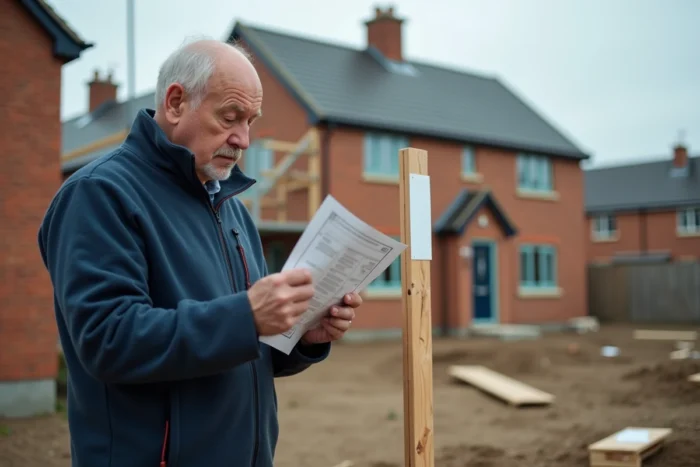
Continuous display of the panel on the site: the proof that protects the project
Displaying a compliant panel is not enough. The urban planning code requires continuous and visible display from the public road throughout the duration of the appeal period. An interruption, even for a few days, resets the clock to zero.
In practice, a panel torn away by the wind, turned over, or moved to allow a construction vehicle to pass constitutes a breach of publicity. The appeal period for third parties then starts from zero from the day regular display resumes.
Double report by a judicial officer
Urban planning litigation practitioners now standardly recommend a double report by a judicial officer (formerly a bailiff). The first report is made when the panel is installed, and the second after the expiration of the appeal period.
This proof strategy covers two angles: it establishes that the panel contained all mandatory mentions from day one, and it certifies that the display was not interrupted. Without this double report, proving the continuity of the display in case of a dispute becomes very difficult.
- First report: verification of the compliance of mentions, readability from the public road, and the installation date on the site
- Second report: confirmation that the panel remained in place, readable, and unchanged throughout the required period
- Retention of both reports with the preliminary declaration file, including after the completion of the work
Support and dimensions of the preliminary declaration panel: criteria for valid display
The preliminary declaration panel must comply with minimum regulatory dimensions defined by the urban planning code. Downloadable PDF templates are generally calibrated for these dimensions, but the choice of printing support determines the durability of the display.
A panel printed on standard paper does not withstand the elements. After a few days of rain, the mentions become unreadable, which amounts to a lack of display. The support must be sufficiently rigid and water-resistant to last several months outdoors.
Comparison of printing supports for construction panels
| Support | Weather resistance | Home printing possible | Estimated outdoor duration |
|---|---|---|---|
| Standard laminated paper | Low (vulnerable joints) | Yes | Several weeks |
| Expanded PVC (Forex type) | Good | No (professional printing) | Several months |
| Hollow polypropylene (Akylux) | Very good | No (professional printing) | Several months to over a year |
| Dibond panel (composite aluminum) | Excellent | No (professional printing) | Several years |
For a preliminary declaration, hollow polypropylene offers the best cost-to-resistance ratio. However, a panel printed at home on paper must be protected by thick lamination and fixed on a rigid support to remain readable throughout the display duration.
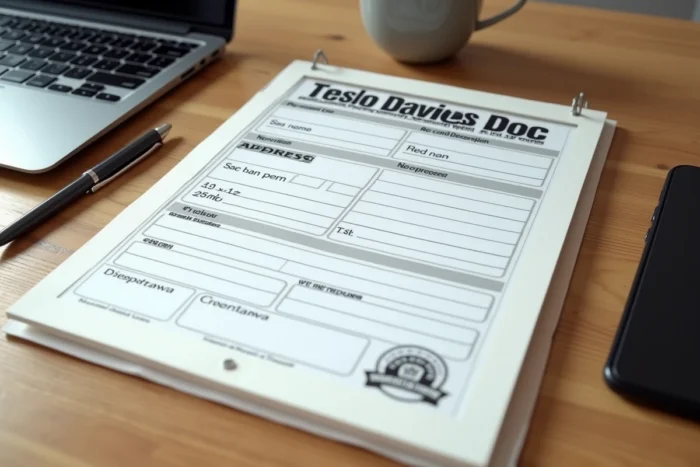
Mandatory mentions of the preliminary declaration panel: checklist
The downloadable PDF template must include each mention required by the urban planning code. Any omission prevents the appeal period from running.
- Name of the beneficiary (or company name for a legal entity) and date of issuance of the authorization
- Registration number of the preliminary declaration assigned by the town hall
- Nature of the work and area of the land, expressed in the exact terms of the cerfa
- Address of the town hall where the file can be consulted, with mention of the right of third parties to appeal within two months
- Cadastral references of the concerned parcel
Each field must reproduce the data appearing on the decree or the receipt of non-opposition issued by the town hall. Copying the information word for word from the official document remains the safest method to avoid any sanctionable wording deviation.
A compliant panel, placed on a durable support and documented by a double report, constitutes the only combination that truly secures the project against a potential appeal. The downloadable PDF template is just the starting point: it is the rigor of the display on the site that determines the legal solidity of the preliminary declaration.